Monday, December 31, 2012

Happy thirteen

Here's wishing you all tight lines, staunch points, steady retrieves and a downhill pack to the truck in twenty thirteen!

Saturday, December 29, 2012

way down south

Over the Christmas holiday we made a quick trip down to far south Texas to visit family. My cousin had arranged a Christmas Eve duck hunt via airboat in some of the back bays of the Laguna Madre system. Reports of recent hunts were very encouraging, as a general drought down there has moved a lot of the birds out to the bays. On the other hand, few things make me more nervous than going on a hunt or fishing trip after hearing about how great conditions have been lately. Somehow, that always seems to work out to "you shoulda been here last week". Dawn:
We started off with a short boat ride to a palatial blind on a back waterway. Once the blocks were out and the boat moved back, we waited for shooting light and listened to the cries of various shorebirds. Those cries were particularly easy to hear, as the wind was nearly completely still.
Not surprisingly, the ducks didn't really move given the bluebird conditions. We had a few come in: a greenwing teal drake, a mottled duck, and four spoonbills all fell, but we had been hoping for pintails, mottled ducks, wigeon, gadwall, redheads and maybe some divers, not spoonies. Given the conditions, we loaded up and went out to a couple of blinds near the Intercoastal. There, a lone hen redhead came in and fell, with several big flocks trading well out or range. On the ride out, we saw tens of thousands of birds out on the flats. Here are a few hundred:
Since things weren't working out, we moved again, this time to a back channel between a couple of bays.
Though things were still slow, this last location resulted in a small bunch of snow geese coming in to the spread.
We also had a few pintails come in.
Even though we didn't get into a bunch of birds, it was a good hunt with family and a great experience getting to see a bunch of the backcountry that is normally inaccessible. Much of the time we were running over four or five inches of water (lying on top of a very soft bottom) and, absent the airboat, never could have gotten there. The shorebirds were a kick to watch, with roseate spoonbills, snipe, yellowlegs, long billed curlews, brown and white pelicans, and dozens of others I can't identify trading about and around the decoys. For that matter, hunting ducks in a tee shirt is a bit of a novel experience. It's pretty hard to beat a holiday hunt and catching up on the year that's passed while waiting for birds to come in. Of course, the weather swapped around, with a nice stiff north wind, the day after Christmas. I'll bet the guys out there slayed them.

Sunday, December 09, 2012

First duck of the year

That's about 2 inches of water and the rest is sticky mud, which makes having a dog to send out for the bird even better. A front was supposed to blow through today, so A and I headed to some salty little ponds not too far out of town. Water is, unsurprisingly, low and before the morning really got going the wind laid some and the temperature stopped dropping. Given the conditions, there wasn't much going on to move the birds and only a very few ducks were flying. We missed a couple of chances but ended up with 2 mallards, one of which donated two breast fillets for prosciutto and the other of which is destined for stir fry or some other quick cooking. Not bad for our first waterfowl outing. Meanwhile, the wind is tearing down out of the North and braised oryx shanks are about ready for dinner. Tomorrow will likely be a great day to be on the water.

Sunday, November 25, 2012

Trophy Shot

We were very much meat hunting this year, looking for the first buck (or first two bucks) we could get to. An obliging fork horn is now in the freezer, all except for the bits and bobs that were ground into sausage, of which I'll write a bit more in the future.

Sunday, October 28, 2012

Tastes Like

We had our first frost the other night and, although it wasn't a hard frost, tender things like peppers and basil have bit the dust and the tomatoes are knocked well back. Consequently, A and I have some last of the season canning to accomplish. We've put a bit by this year, including one wild fruit new to me. On an unsuccessful mushroom hunt in late summer, we came across some heavily fruiting elderberry trees. The first tree we saw had quite a few berries on it, but was a lone tree. I'd seen elderberries fruiting in the mountains before, but never very heavily and this lone tree was interesting but nothing more than that. However, on our way off the mountain, we passed a number of trees drooping with ripe fruit, inspiring us to stop and pick what turned out to be 11 pounds of berries off three trees in just twenty minutes or so.
Lots of elderberries.
A day or two later, we sat down in front of the tv and de-stemmed the whole batch, then weighed it out.
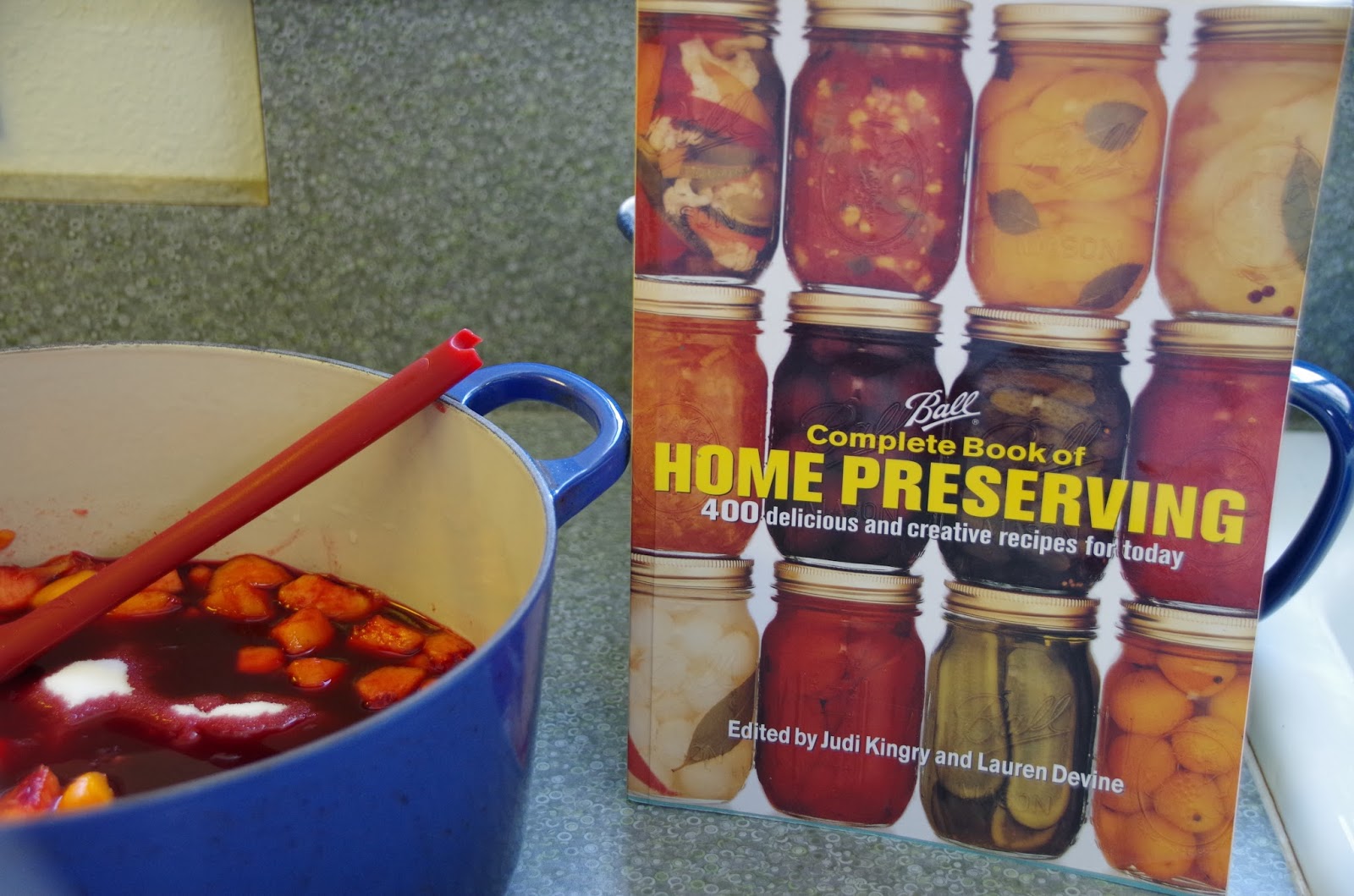
We cooked the berries in a bit of water to soften them, then extracted the juice- enough for 3 1/2 batches of jelly and a batch of "membrillo" as well. Membrillo is quince paste cooked to a jelly-like state, often paired with cheese. The elderberry membrillo, rather than orange color you get with quince, is the beautiful dark purple you see below. Slightly sweet, we dusted it with sugar to keep the wedges separate. Served alongside manchego cheese, lucques olives and perhaps some thinly sliced tasso, it is very good.
Both the elderberry membrillo and the jelly have a flavor similar to dark cherries, although slightly less sweet and with a vinous funk near to that in some red wines- a slightly green, earthy note that recalls to me a bit of the flavor of the cambium of some trees. (What, you never split a piece of green oak and thought it smelled so good you had to taste it, or wondered what elk find so appealing in aspen bark?) The flavor isn't quite the same, there is another note, perhaps a little like latex or green fig that also goes along with it. However, all this is a subtle undercurrent to the overall tart cherry flavor, making elderberry jelly or paste both reminiscent of and more complex and appealing than cherries.
Once again, a wild food that is unique and very, very good. The juice of elderberries is supposed to be a tonic and a bit mixed with a citrus soda (or likely, club soda and vodka) was quite nice. With any luck the elderberries will come on again next year and, if they do, we'll spend some time up in the mountains gathering more to put aside.

Sunday, October 14, 2012

Two Months

I've  now spent two months in one small region of Alaska, a week at a time, in eight trips spread over ten years with each trip occurring between mid-August and late September. In this way, you get to know a little bit about a place, at least in a particular slice of season. In much the same way, I feel I know a particular series of ridges in western Colorado, based upon eight or nine fall hunting trips spread over twenty-some years. For that matter, I used to know a particular mountain in western New Mexico and I have a fair idea of a particular basin in the northern end of that state, along with a few other spots.

 I've mentioned  before some of the various trips we've taken to fish for silver salmon (see here, here, here and here). Consequently, I don't have much new to say, more of a report. This year saw a little bit of sun and also a fair bit of rain. Over one 48 hour period, about 7 1/2 inches of rain fell. It felt like more to me, but that's what the web says fell for those days, and I'm sure the web wouldn't lie. I don't really have the experience to grok that level of rainfall, as less than that has fallen in my slice of New Mexico for the last 18 months. In any event, the rain brought all the rivers, creeks, and sloughs up quite a bit and rendered them unfishable. We ended up on some of the smaller tributaries and got to wade through some waist-deep water in head-high alders.


The fishing was pretty tough and most of the fish ran a bit smaller than we're used to, lots of eight pound fish instead of tens and twelves. For wildlife, apart from the usual ducks, geese, cranes and swans we had some river otters swim right up to us. No bears, apart from one little black bear right in town.


This portion of Alaska strikes me a lot like the Grand Canyon- photographs, at least my snapshots, never capture the scale of the country. It feels a little bigger than the already big Western landscapes that I call home.


Thinking about the near-annual, one-week-only connection with a place over 2,500 miles from my home, I'm reminded of the conflict between local and visiting interests and the power of conservation movements. I've put a bumper sticker (only one that actually says anything) on my truck that addresses an issue local up there. Driving on a high-desert highway, I've had occupants of an overtaking vehicle honk and wave thumbs-up in apparent agreement, again, thousands of miles from the scene of the issue. I like to think that hunters and fishers are more than regular tourists- that if a place special to us is changed for the worse we just don't find another spot and move on, because our time in those places is more significant, that we'll invest a little more and fight a little harder for them. In the meantime, we'll head up there with friends and family as we can, enjoying the cool clean air and the rain, the scenery, and the salmon. One of the best weeks of the year.

Sunday, August 26, 2012

Out of Africa

I think I need another few hundred hours of artificially chilled air to cool off, core temperature wise.

A and I have been pretty busy for the last month or so, and, a couple of weeks ago we completed a big game hunt that is unique in my experience. This is the first time I've hunted large animals in conditions that could fairly be called "Africa hot".

As witnessed by the paucity of blog posts, reflecting a paucity of time afield, work has been kicking our butts the last couple years or so. Reflecting the lack of time afield is the fact that our freezers have gotten pretty bare of red meat. In an effort to increase our opportunities for big game, A and I put in for elk in some relatively local areas (that don't offer great odds of drawing), deer in similarly local areas (and drew for November), put in for antelope (which are very long odds nowadays) and also put in for oryx off the White Sands Missile Range. Tags on the Missile Range are popular and hard to draw, but off-Range tags offer better odds. Most of the animals are on the Range where the habitat is good for them, but off-Range hunts run for an entire month rather than a weekend to give you a better chance. Since oryx breed year round, the hunts also run year round. As part of the odds game we put in for hunts scheduled for June and August, months not often associated with big game hunting and featuring less competition for tags. We also applied for tags separately, hoping one of us would draw.

I drew, for August, but A did not draw at all (we also blanked on elk). Tag in hand, back in July we headed over for the Tularosa Basin and scouted some BLM and state trust land. Since we lucked into the draw for an on-Range oryx  hunt a couple of years ago, as recounted here, we had some ideas about what we were looking for. We found a few likely locations and got some tips from a guy much more familiar with the area. Our first day out, we started glassing at the first spot and, within minutes, A spotted a pair of animals.She stayed up on a little promontory keeping an eye on the oryx through the spotting scope while I dropped down into a wash and headed in their direction. Getting nearly to where one of the animals bedded in the shade of a salt cedar, I hit a fence that marked the edge of huntable territory. Leaving the oryx to lounge in safety, we headed to other promontories and spent the rest of the day glassing and checking for tracks. Sixteen hours and nearly four hundred road miles passed without success.

Another Saturday, and we headed out again. Glassing first thing in the morning, A again spotted an oryx nearly right away. Again, it proved to be a pair of animals, feeding and meandering around. Again, I dropped into a wash and headed down toward the animals. This time, the oryx crossed over the fence and off of public land before I was halfway to their original location. Moving over to another wash to work my way back to A, I cut a pair of extremely fresh tracks that headed into a sandy pocket below a low ridge. I followed, expecting to come up on the oryx somewhere under the ridge in some fairly heavy brush. Instead, the animals had wandered up over the ridge and into a broad shallow draw on the other side. Two and a half hours into the hunt and with the heat rising, I decided to head back so we could check out another location. Before doing so, I eased over a shoulder of the ridge to take a look at the country over there just to get a better feel for the lay of the land. No sooner had I gotten over to about where I could see, but a pair of oryx started up and to my left. They paused a minute and I shot the slightly larger second animal.

Once the oryx was down, I got in touch with A. We met up to fix relative locations and then she headed back to the truck to move it to a point somewhat nearer to the animal while I proceeded with field dressing. A bit over a mile from the truck, something near that from the nearest vehicle access, we had our meat.


Usually, New Mexico benefits from the "monsoon" rains in August, a weather pattern where moisture from the Gulf of California moves into the Southwest to condense over the mountains, resulting in afternoon thundershowers and cooling things down a bit. Not so much this year. August has been darned hot and the two towns closest to where we got  this animal had highs of 102 and 103 F, respectively. I had two quarters off and in what scanty shade was available when A made it over from the truck. She helped me with the last two quarters and sawing out the skull plate. With everything we couldn't carry on a piece of plastic under a mesquite, A took the backstraps, loins, every bit of miscellaneous bit of gear out of my pack and some other odds and ends while I took a forequarter and a hindquarter. Although we had very little elevation loss or gain, that stretch out to the truck was one of the more challenging I've done in a while. All water in us, sandy, a good load and hotter than all get out, I had to stop every hundred yards or so for the last third and kind of stopped enjoying the hunt. The fact that every year I'm a bit older and that I'm pretty much completely out of shape and a bit out of practice packing might have contributed something to the situation, too. In any event, the hard half out, we sat in the truck, cranked up the air conditioner, had a cold drink, had another cold drink, and gathered ourselves up. Out and back with another quarter each, we had all the meat on ice and a cold  beer in hand  by 4 pm.


The last oryx hunt, on-range, was interesting but crowded. In contrast, we only saw a couple of other hunters this time, those rolling up on the highway as we  brought out the last load. It was harder to find animals and they were much more scattered  but, all in all, this was more my preference. Now, the meat is cut and wrapped, the horns are on the fence and we're looking forward to fall.